Many people underestimate the power of good prompts.
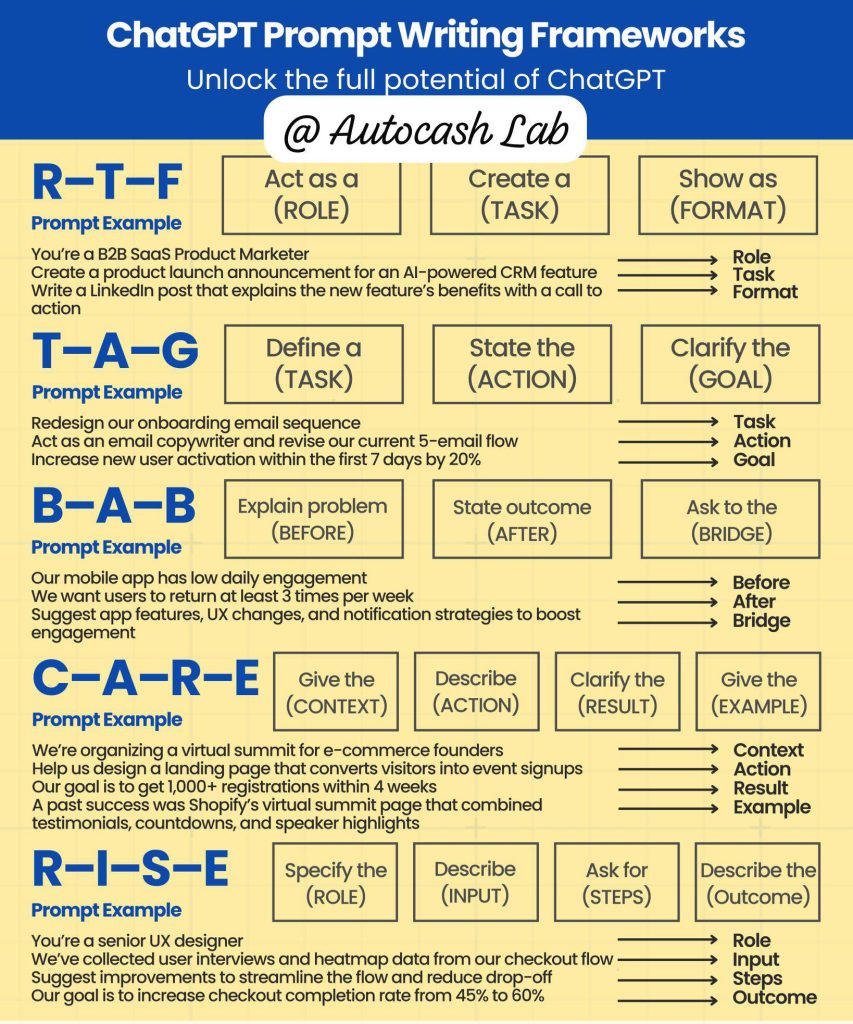
Here are 5 frameworks to write effective prompts:
bookmark this to upgrade your prompts ]
1. R-T-F
– Act as a (ROLE)
– Show as (FORMAT)
Example:
– ROLE: You’re a B2B SaaS Product Marketer
– TASK: Create a product launch announcement for an Al-powered CRM
– feature
– FORMAT: Write a Linkedin post that explains the new feature’s benefits with a call to action
2. T-A-G
– Define a (TASK)
– State the (ACTION)
– Clarify the (GOAL)
Example:
– TASK: Redesign our onboarding email sequence
– ACTION: Act as an email copywriter and revise our current 5-email flow
– GOAL: Increase new user activation within the first 7 days by 20%
3. B-A-B
– Explain problem (BEFORE)
– State outcome (AFTER)
– Ask to the (BRIDGE)
Example:
– BEFORE: Our mobile app has low daily engagement
– AFTER: We want users to return at least 3 times per week
– BRIDGE: Suggest app features, UX changes, and notification strategies to boost engagement
4. C-A-R-E
– Give the (CONTEXT)
– Describe (ACTION)
– Clarify the (RESULT)
– Give the (EXAMPLE)
Example:
– CONTEXT: We’re organizing a virtual summit for e-commerce founders
– ACTION: Help us design a landing page that converts visitors into event signups
– RESULT: Our goal is to get 1,000+ registrations within 4 weeks
– EXAMPLE: A past success was Shopify’s virtual summit page that combined testimonials, countdowns, and speaker highlights
5. R-I-S-E
– Specify the (ROLE)
Describe (IMPoT
* Ask for (STEPS
– Describe the (EXPECTATION)
Example:
– ROLE: You’re a senior UX designer
– INPUT: We’ve collected user interviews and heatmap data from our checkout flow
– STEPS: Suggest improvements to streamline the flow and reduce drop-off
– EXPECTATION: Our goal is to increase checkout completion rate from 45% to 60%
Good prompts = better results.
Try these frameworks today!
Follow me @ facebook.com/autocash.lab for more