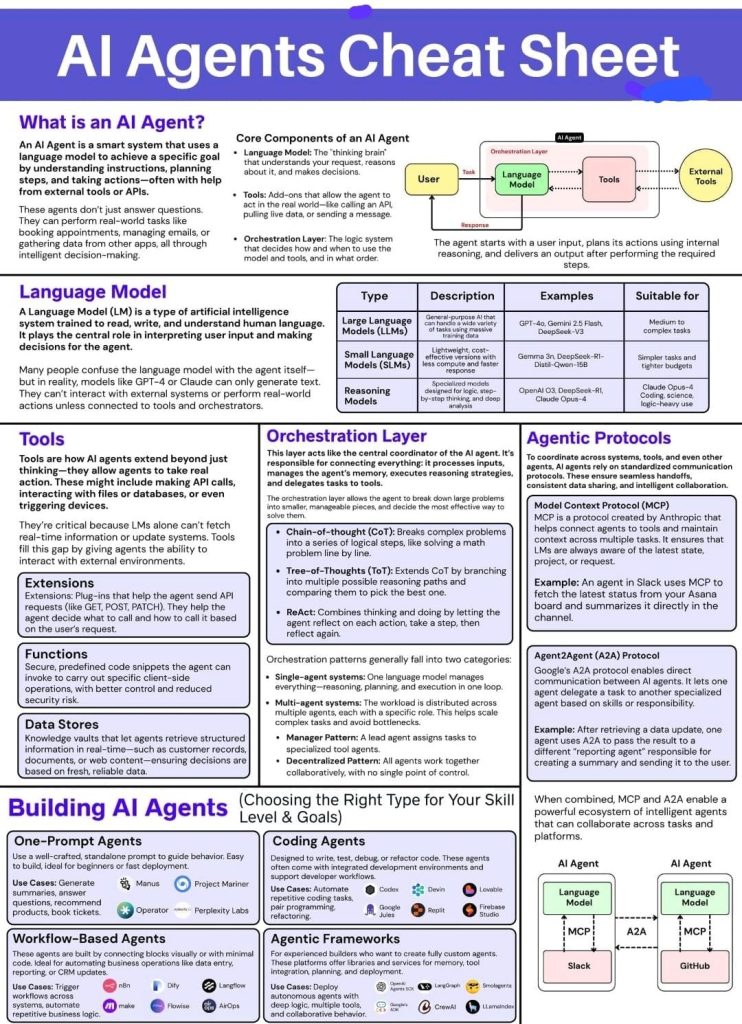
This is a good starting point if you’re trying to make sense of AI agents.
There’s a lot of talk about agent frameworks right now, but at the core, most of them build on the same set of ideas.
This cheat sheet gives a simple overview of the key building blocks, from LLMs to orchestration to protocols. Useful whether you’re exploring agent tooling, building internal automations, or just trying to understand the space better.
What is an AI agent?
– Agents combine reasoning with the ability to take action.
– They don’t just respond, they can plan, call tools, access data, and trigger real-world effects.
Language Model
– This is the core reasoning engine. It interprets input and generates plans or responses.
– But by itself, it can’t take real-world actions.
Tools
– APIs, functions, and external integrations that agents use to do useful work, like querying a database, sending an email, or calling a webhook.
Orchestration Layer
– This layer coordinates what the agent does, how it reasons (via CoT, ReAct, etc.), how it sequences steps, and how it interacts with tools.
Agentic Protocols
– Protocols like MCP and A2A enable agents to collaborate across platforms (e.g., Slack, GitHub) and maintain context across tasks.
Building AI Agents
– There’s no single way to build an agent.
– Some start with a single prompt. Others use low-code platforms. Some teams build full custom frameworks.
The cheat sheet maps out the trade-offs.
If you’re trying to understand the agent space, or explain it to your team, this breakdown might help